Energy poverty is often discussed through statistics, indicators and policy documents. These tools are essential for understanding the scale of the challenge, but they do not always capture the full complexity of how energy poverty is experienced in everyday life. But what happens when people describe those experiences in their own words, in their own communities and on their own terms?
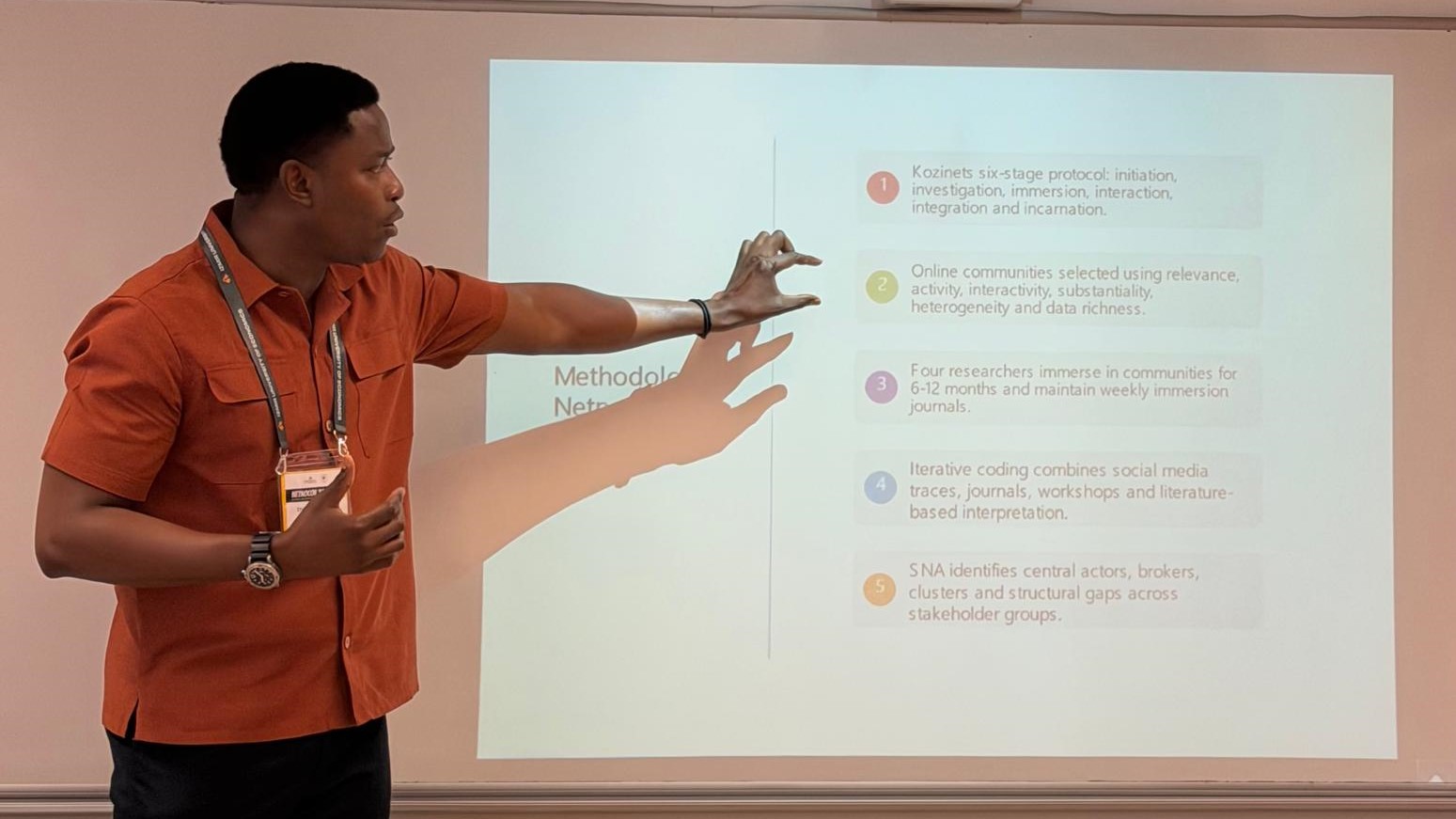
This question lies at the heart of the research presented by Trevor Omoruyi from the University of Chester at NETNOCON 2026. His contribution, developed through a collaboration between the University of Chester, the University of Cape Town, SITES and the University of Banja Luka within the ENPOWER project, explores the potential of Transformative Netnography as a complementary method for understanding citizen perceptions of energy poverty in widening countries.
Looking at conversations as they naturally happen
Transformative Netnography builds on the study of online cultures and communities, but with an additional ambition: to contribute to tangible social change. Rather than creating an artificial research setting, the methodology examines conversations that are already taking place within digital communities.
For the ENPOWER research, this means exploring online spaces such as Reddit, subreddits and Quora, where people discuss social, environmental and energy-related issues in their own words. These spaces can provide a different type of evidence: conversations that emerge organically, develop over time and are led by the people participating in them.
As Trevor explains, the approach can help researchers understand phenomena in a more organic way, particularly because citizens themselves facilitate and direct conversations within spaces where they may feel less judged or constrained. The longitudinal nature of these discussions can also offer a valuable perspective, with conversations unfolding over weeks, months or even years.
Giving citizens space to define the conversation
One of the central ideas behind the research is that citizens should not only be treated as sources of data. They are also actors who shape the conversation. This is particularly important when studying energy poverty. The term may have a technical or policy definition, but the lived experience behind it can vary considerably. For one person, energy poverty may mean choosing between heating and food.
For another, it may involve living in an inefficient home, struggling with rising bills, or being unable to access support schemes. Others may experience energy vulnerability through housing insecurity, social isolation or limited access to information.
Digital communities can provide a space where these different experiences emerge in ways that are not necessarily anticipated by researchers.
Rather than asking citizens to respond to a predetermined set of questions, Transformative Netnography can help researchers understand what people themselves consider important.
This makes the method particularly relevant to ENPOWER’s wider interest in citizen engagement and socially inclusive energy transitions.
Understanding the wider ecosystem
Energy poverty does not exist in isolation. It is connected to housing, income, public policy, infrastructure, energy markets, social services and the decisions made by a wide range of institutions. For this reason, the research also considers the relationships between different actors within the wider energy poverty ecosystem, including academia, policymakers, industry, civil society, citizens and the environment.
Mapping these relationships can help researchers develop a more holistic understanding of how energy poverty is discussed and experienced. It can also reveal where different perspectives converge, where tensions emerge and where important voices may be missing from formal decision-making processes.
Complementing traditional research
Traditional methods provide important structured evidence. However, they can sometimes capture only a particular moment or reflect the questions researchers have already decided to ask. Organic online conversations can offer another layer of understanding by revealing how people discuss issues spontaneously, what concerns emerge repeatedly and how perceptions evolve over time.
This additional perspective can contribute to the triangulation of research findings. For ENPOWER, the aim is to develop a richer evidence base that can inform recommendations and help identify emerging issues that may otherwise remain overlooked. As Trevor notes, the research has the potential to support clearer strategic pathways for Bosnia and Herzegovina and other widening countries, while also providing a foundation for identifying issues that could be addressed through future research and projects.
From citizen voice to social change
The transformative dimension of the methodology is central to its purpose. The research is not only interested in observing conversations about energy poverty. It is also concerned with how knowledge can contribute to social change. This raises an important question for energy transition research: how can citizens be meaningfully engaged while ensuring that they have the opportunity to express themselves in ways that feel authentic?For Trevor and the wider research team, Transformative Netnography offers one possible answer.
By studying conversations in the spaces where people are already communicating, researchers can gain access to rich, naturally occurring data while reducing the need for resource-intensive forms of data collection. The result is a methodology that combines social research, digital observation and a commitment to giving citizens greater visibility in discussions that directly affect their lives.
A research approach with potential beyond ENPOWER
The presentation at NETNOCON 2026 also marked an important opportunity to place ENPOWER within a wider methodological conversation. The research demonstrates how approaches developed in digital and social research can be applied to one of Europe’s most pressing energy challenges.
For ENPOWER, the potential significance extends beyond the immediate project. By complementing existing research methods with organic citizen-generated data, Transformative Netnography could offer valuable insights for other initiatives working on energy poverty, sustainability, citizen engagement and inclusive transitions. At its core, the approach is based on a simple but powerful principle: people experiencing energy poverty should have a voice in shaping how the problem is understood and addressed.
By listening to citizens where they already speak, researchers can gain a more nuanced understanding of the realities behind energy poverty. And by bringing those insights into research and policy discussions, the distance between lived experience and institutional decision-making can begin to narrow. That is the ambition behind this research: not simply to study citizens’ conversations, but to ensure that those conversations can help inform more inclusive, evidence-based and socially responsive energy futures.